🏍️ Kawasaki z400j3 -82 rebuild
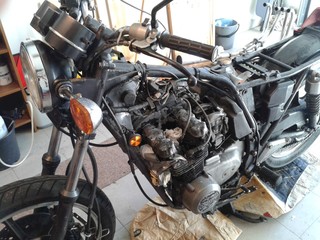
One Kawasaki z400J3 from 1982 was found in a garage just outside Borås in autumn 2013. The owner said the engine had been running ten years earlier but was put aside due to the owner’s health condition. After filling the cylinders with a bit of diesel and charging the battery, I tried to start it — and it fired up in a blue cloud. I bought it for 8 KSEK and planned a café racer build.”
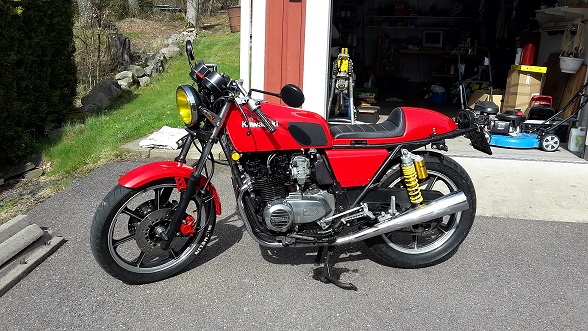
The engine was taken apart and cleaned, the valves were adjusted, the clutch replaced, and both sprockets and chain renewed. The fork was reconditioned, and the brakes rebuilt with new pads and fresh fluid. It received new tires and a freshly painted frame. The electrical system required a complete overhaul — the 30‑year‑old wiring was a mess and much of it had to be replaced.
In May 2014 it was time for the inspection.
It failed the first inspection because they found a crack in the frame beside the footpeg. After welding the damage, it passed, and I was finally allowed to ride the old lady on the streets. The summer 2014 I was driving it more or less without any
major customization.
The concept of the Z400j follows the theme found in most of the top-selling Japanese motorcycles at the time, the early eighties - an across-the-frame in-line four-cylinder engine mounted in a duplex-cradle chassis.
The Z400J3 is an extremely compact machine with a short wheelbase. It feels small, thanks mainly to a narrow fuel tank and tidy proportions around the side panels that allow the rider to place both feet flat on the ground at traffic stops.
The frame itself appears conventional in that it has a large diameter backbone supporting the steering head. But it is supported above the engine with massive gusset plates which effectively stiffen the front end of the structure. The front fork, a smaller version of the unit found on the big Z1000, appears also to be overly strong with leading-axle sliders with big clamps for the front-wheel spindle. At the rear, the swinging arm pivots on four needle roller bearings.
The stiffness of the front fork is necessary because of the long suspension travel and the steep 64‑degree steering head angle.
Were it otherwise, the fork would flop around uncontrollably when at full
travel. As it is, it imparts a perceptibly high degree of stability in the z400J
that puts it on a par with the best bikes on the road.
Some riders might argue that the
suspension is harsh, and that's certainly true although it's not because of the
spring rates.
Given a lack of stiction in the suspension plus a lighter front rate with more
preload this set-up would work very well, offering a good ride with steadiness
in bends. But the ride feels stiff and is none too mitigated by my hard seat....
Fortunately, nothing is lost in the overall handling. The steering is excellent, being neutral and light to control whether the bike is being weaved through dense traffic or carved through tight bends.
The sintered‑pad disc brakes that were found on all the Kawasakis at the time, you have a chassis package that marks high for motorcycles from Japan.
Two thin discs are used at the front with floating calipers while the rear unit is a simple drum brake. Only criticism is of the excessive reach to the front brake handlebar lever.
In performance, the Z400's engine matches the chassis perfectly. Peaking at a claimed 43 bhp at 9,500 rpm with the red line marked at 9,500 rpm, it easily urges the bike to almost 150 Km/h flat out and puts indicated cruising speeds of around 120 Km/h comfortably in the grasp of the rider even when there's only small sections of open road to play with.
Much of the engine's excellent power is derived from the use of double overhead camshafts and the four free-breathing 22mm-choke Tekei carburettors. The crank runs in plain bearings and drive is through a Morse-type chain and gears to the wet clutch. There is the use of another Morse-type chain with an automatic adjuster for driving the camshafts.
Some of the surprisingly sharp throttle response and strong acceleration are due to the six‑speed gearbox and its wide ratios. Gear change action is slick and noiseless and the 'box retains the useful neutral-finding dodge that stops you selecting second from bottom at a standstill.
Kawasaki appear to have selected the gear ratios with drag racing in mind for the rev drops between gears are as similar all the way through the range instead of having a large gap between bottom and second and closing up the other ratios. In normal use though the engine is so flexible, pulling cleanly and usefully from as low as 1,000 rpm in top, that the lower ratios hardly ever get used.
The Z400J3 fires like a cannon from the gate.
With no kickstart lever, it's just
as well the self starter is reliable. The engine fires up cleanly and is helped
on cold mornings by the throttle-valve lifter incorporated into the choke
mechanism. The clutch is annoying though. Like an old English Triumph, it would stick
after being left overnight.
Unfortunately, the worst feature of the machine is vibration.
When used as a sports bike in the twisties it's doubtful if you'd notice it, but
on motorways the vibes above 5,000 rpm are enough to render the rear-view
mirrors useless.
Otherwise, it’s a great little bike that suits my needs perfectly for fun rides on the curvy roads near my home.
Before restoration, 2013 |
After rebuild, 2015 |
|
|
Some of the customization:
A lot of pictures was taken during the build, you can watch them all in the album.
The Specification
|
Make Model |
Kawasaki z400j3 |
|
Year |
1982 |
|
Engine |
Four stroke, transverse four cylinder, DOHC, 2 Valve per cylinder. |
|
Capacity |
399 cc / 24.3 cu-in |
| Bore x Stroke | 52 х 47mm |
| Cooling System | Air cooled |
| Compression Ratio | 9.5:1 |
| Induction | 4 x 21mm Teikei carburetors |
| Ignition | CDI |
| Starting | Electric |
|
Max Power |
48 hp / 35 kW @ 10500 rpm |
|
Max Torque |
34.3 Nm / 25.2 lb-ft @ 8500 rpm |
|
Transmission |
6 Speed |
| Final Drive | Chain |
|
Front Suspension |
Telescopic forks with progressive springs |
|
Rear Suspension |
Dual gas assisted dampers |
|
Front Brakes |
Single 236mm disc |
|
Rear Brakes |
Single 140mm drum |
|
Front Tyre |
90/90-19 |
|
Rear Tyre |
110/90-18 |
|
Dry Weight |
179 kg / 394.6 lbs (before customization) |
|
Fuel Capacity |
15 Litres / 3.9 US gal |
|
Top speed |
154.0 km/h (95.7 mph) (this is theoretical, it will never happen, 140 km/h is more realistic) |